February 7, 2012

NOFA Winter Conference


This year's winter conference held by the Northward Organic Farmers Association in Saratoga Springs was an exciting time for Windflower. We received a farm scholarship that allowed our workers to fill the conference weekend with the classes of our choice. There was a wide range of topics covered, from raising livestock to medicinal herbs as well as homesteading skills and growing hops. They kept us well-fed with organic foods donated by dozens of local farms and businesses. It was cold outside, but no snow like last year.

I specifically enjoyed my class on using a European scythe. Great fun! The demonstration includedin learning to use the smithing tools necessary for sharpening the blade and how to work in a group to get a hole field done. Now, I'll admit that I'd rather mow a field with a tractor, but just collecting all these bits of old-fashioned knowledge thrills me. I own a lot of old tools and have them because I know how to use them. Maybe I can add a scythe to my collection soon!

NOFA is also a fun place to meet people. I enjoyed my meals with various farmers (including a mushroom grower who appeared in the Fall publication of Edible East End) We shared laughs, ideas and coffee, then parted ways for more classes. Even with all those people I ended up meeting a guy who long ago worked for Ted when he was in business with a farm down the road. It was only a year before my time there, but we had tons to talk about. Like most if the conference attendees, he was there with the prospect of starting his own farm, and NOFA has sort of a stereotype that a farmer is someone who owns a farm. I chatted with him about my philosophy of who a farmer really is and he seemed encouraged knowing that he didn't necessarily have to invest everything he owned in a piece of land just to earn the title of farmer. My husband is an electrician that works for a company, but he's still an electrician. Owning a company or business isn't what makes your proffesion. I've worked on Windflower for seven years; I'm a farmer. And without second class farmers there would be a shortage of skilled workers and farms could never grow the way our vegetables do.

December 14, 2011

Winter Share and Europe

I’m tapping my feet to the beat, 107.1 Country is playing the latest honky-tonk. Caffeine is pulsing through my veins, a chill is in the bones, it’s 8:55. If I get to work early, I like to take the time to relax until work starts. I call it my ‘office work’ time, doing paperwork, reading another paragraph or two from the book I’m working on. Then I get out of the truck, and the bright, clear December dawn is banishing the sharp morning chill, replacing it with the feel of a sun-warmed face that peers off in the distance towards the tunnels. You lift the plastic up, like someone curiously lifting the cover of a new car, to see how the greens are doing since you planted them months ago. They look like something from Jurassic Park, especially the kale, which clearly belongs to the Mesozoic and not our era. Luckily, they’re healthy, lush, and ready to harvest.

We’re quite proud of the greens this year. We planted plenty, and got lucky with an exceptionally warm September, and hopefully you’ve noticed the bounty! Today we harvested December’s spinach, kale, and choi. We already bagged your apples on Monday (to the soundtrack of the Lord of the Rings. Two of three of us are in a re-read, it made sense). The Chuckies, as I call them (the two Vermonters) bagged root crops on Tuesday, and tomorrow we’ll all descend on popcorn bagging and a little more greens harvesting. Friday we’ll pack the boxes with everything and load the truck. From there, Ted takes over as driver, and you’ll enjoy a nice view as you open your (perhaps) first present of the holidays!

In the back of my mind as I work, I rehearse to myself a million questions. Did I get those tickets yet? Hosts confirmed, languages being studied? Because yes…the rumors are true. I’m going on a four month sabbatical from Windflower, from home here in Washington County. The first leg is Turkey, there I’m visiting old friends from college for several weeks, then going on to WWOOF. WWOOF (pronounced just like woof, like a dog) stands for Willing Workers On Organic Farms. It’s an international organization with branches throughout the world. The premise is simple- hooking up farmer-hosts with volunteers, who receive room and board in exchange for labor and experience/knowledge.

My first stay will be in Turkey after visiting friends. I’ve made arrangements with a dairy farm an hour outside of Istanbul. The supreme irony is that I’ve grown up my whole life in Washington County, the premier dairy county of New York, and never worked on a dairy farm. My first experience on one will be thousands of miles away, across the ocean, in a world apart.
My second leg of the trip will be to visit a friend in Germany for a few days. From there I move on quickly to my next host, in the land of Brittany, in the west of France. My host farm is a homestead engaged in market gardening, in a small village nestled in a part of France known for its Celtic language and customs, descended from 5th-7th century Briton Celts fleeing from the Anglo-Saxon invasion of England. The farm is near to a region fabled to be the gates of Hell, but hopefully my part will not turn out quite that way. It’s about ten or fifteen kilometers away, apparently a mist-filled region of rocky hills and valleys where travelers have lost themselves for thousands of years. It adds a bit of adventure to think that if I miss the right bus stop I might be in Hell!

After about a month there, I’ll take a ferry trip across the Irish sea, landing in Cork. I’ll spend a few days in independent travel in Ireland to see where some of my family came from, and then I head to the region of Gweedore. It’s a region of four or five towns in the far northwest of Ireland famed for retaining the old Irish culture and language. Partially because of this, it’s the center of traditional Irish music, and contains the hometown of Clannad (and therefore Enya). The farm raises rare heritage breeds of pigs and cattle for slaughter and sale, along with growing vegetables for home use.

From there I take a bus to the airport, and return to my home. By then, home itself will be an exotic destination, I think. Always it’s such that when I come home, I have new eyes to see the world with, including my own!

November 19, 2011

Diary of a Homesteader


DEER HUNTING

Thanksgiving conjures up thoughts of warm houses, pumpkin pie, and roast turkey on a table filled with family. But it also brings another thing to mind. A past-time ever older than the Pilgrims who held the first rendition of this holiday: hunting. Some might romanticize the Native American hunt and its ties to life and land, but hunting in our era is no less romantic. As soon as your sitting in the woods in the cold, surrounded by the elements, nature has control. You can't stop the wind from carrying your scent or make the deer run into your clearing, you just have to wait and watch while everything runs its course around you. Squirrels make a whole lot of noise and are rather careless about being heard while they hunt for their own winter food supply. Birds peck at seeds in the trees above. Geese move from field to cut corn field, flying in their classic 'V' formation overheard. And moving too much willed have the crows gossiping all over the woods about who's sitting under that tree down by the gully. You become a rather small part of the whole.

Though it was only recently that I decided to acquire my hunting license, I have enjoyed the bounty it brings whenever my husband gets a deer. It is not my intention to gross-out anyone who hates the idea of killing an animal or to enrage those who do not eat meat. Each gets to make their own choice and I hunt happily knowing that deer have lived quite free and exciting lives. They've fattened up on corn and soy beans (and lots of Ted's lettuce) then roamed through forest and field making sure they cross every road along the way, stopping in the middle to say hello whenever you are driving.

Deer can populate the countryside with as few as 5 to as many as 100 deer per square mile. Only 10-15% die due to hunting. See, nature has set up a way of balancing wildlife populations on its own through the harsh Northeast winters. Only a small portion of deer will have enough to eat over the winter months (creating a population threshold) and so a hunting season is offered just before the worst of the weather. In a sense, the meat that would go to waste is getting a chance to feed people. Most of the deer my husband and I have tucked into the freezer give us 75-100lbs of meat. It comes out to less than $1 per pound because we had to buy the liscence. Fortunately, for the weak of stomach, there are taxidermists who can cut and package the meat for you. And as for the often criticized taste of game meat, I promise that if you ate chili or tacos or stew at my house without knowing my deer hunting secret, you'd never know the difference.

November 16, 2011

Diary of a Homesteader

So for the Winter this year, I'm going to have a new blogging set up. The titles will let our faithful readers know what sorts of things are going on with Windflower and the crew. Since Daren will be traveling abroad to see Europe and work on various farms, his experiences will show under a designated title. My winter has not always been so lowkey, but this year I will be home to man the woodstove! Thus, my winter blogging: Diary of a Homesteader. Every time you see the title, you'll know what you're getting. Maybe the plight of wintering over chickens, deer hunting, and bottling homemade beer isn't interesting to you, then look for Daren's adventures in Ireland, Turkey, and France. Still, not enough to make you want to read? There will also be updates on the winter share at Windflower. Of course you can also let us know what you'd like to hear about by commenting here on the blog or emailing Victoria.

November 11, 2011

Last Day . . .

Another year gone by.

It's easy to begin thinking about all the things I'd like to do with my time over the winter, but it's also hard to take that last look at the empty fields. Every season I reap another set of memories from them. There were quiet mornings weeding at 6am when no one's coffee had kicked in yet, but we wanted to beat the coming summer heat. Aidan once played The Ants Go Marching on a blade of grass while we waited for a new load of plants to transplant. We sat in the shade and laughed. Daren and I revisited the old ways in Spring when Ted sent us to plant dozens of rows of potatoes by hand. In fact, I can look at any field and recite all the things that have happened there somewhere in the past.

This year's highlight was meeting many new friends in NYC. It has inspired me to want to know folks from other sites since Prospect Heights has hosted the crew two years now and it my main city contact. There are six others, some of whom I've met in passing at our harvest party, but would like to visit personally and bring a canning workshop to.

I could easily get carried away with thoughts. We grew the largest celeriac this year, but still argue that it's hardly a valuable achievement, I mean we don't get e-mails saying "send more celeriac!" It's a farmer-pride-thing. Big vegetables, straight rows, and weedless beds just mean that at the end of a day you can sit back with a cold Saranac and smile while the sun sets. There's no more to do.

And so there is no more to do. Winter will soon take over, and as soon as I've settled into my ways, the itch will come back and I'll be eager to return for a new season. Farming holds some power.

November 4, 2011

Night in Valhala

The sun began to set, the fires were lit, and our greenhouse-turned-meade hall suddenly filled with characters of every sort. Mugs of homemade brew were toted about in Jan's amazing theme of a Viking great hall. Everything from an Ent to executioner, cowboy and mosquito with vials of different blood-types arrived for the food and festivities. Thor himself made an appearance for the night, as he is a friend of Windflower. The white owl at his side was my favorite costume of the evening.

Oddly, most of the crew this season had some sort of brewing project happening in their home. Aaron and Adam made hard cider and meade, Daren brought some wild grape wine, and I had a few bottles of ale aging at home. I did manage to cork and prepare a bottle of apple wine for the party, needless to say, we had plenty to drink. It's hard to say why everyone suddenly had an interest in brewing. Either we were all really happy, a bunch of alcoholics, or depressed. (I was happy, for the record, and wanted to try something different. I'll blog about it later.)

Now, for pictures!

October 28, 2011

Tricks . . .


This is Jan Blomgrem's favorite week of the year when Halloween is just around the bend and the competition arises to see who can come up with the best tricks. In the past Jan has stashed everything from plastic limbs and severed hands in the old carrot patch to stuffed rats and critters in our bins of unprocessed veggies. The skunk in this picture was part of a season long problem with the real thing lurking around our barns and occationaly getting its hands on a garbage can, so you can probably imagine what we all thought when we walked in on this stuffed little guy. Laughs and kudos to Jan. Thought she didn't get me with this one, I was stunned by the scarecrow in the outhouse who didn't say anything when I knocked. That got everyone! I wish we had a camera to record our faces.

Only days away is our annual costume party and we take it very seriously. No one tells what they are going as and the evening is filled with amazing actors who battle for prizes on best costume and actor. Look for pictures this weekend.

October 15, 2011

More Salsa!


Salsa making in the morning was not enough! The crew enjoyed a fantastic show at Symphony Space preformed by the Afro Latin Jazz Orchestra. In other words, another batch of Salsa. There were couples dancing on stage and off as well as some of the big names of Latin Jazz keeping us entertained all night. What an amazing end to our New York Trip! Thank you Prospect Heights for having us!

Canning Workshop


My Saturday morning was spent meeting new city folks and teaching the basics of canning. We set to work preparing onions, peppers, tomatoes, and chiles for a big batch of salsa. Even the elevator in the building smelled like spicy goodness, and I was so grateful to Lynn for hosting us in her beautiful apartment! Everyone got to take home five jars made from Windflower vegetables after going step by step through the process of creating a shelf-stable salsa. We tasted and chatted about the Farm, most of the crew was to answer questions and join the fun.

I learned a little bit about the process of composting in the city and someone was kind enough to take the bag of veggie stuff off to be composted. Big difference from the countryside where I'd never have to think about what to do with a pile of tomato skins and pepper seeds. Thank you to both the old and new faces who came out to join the workshop. We are considering a more frequent canning schedule where I will come down from Windflower and hold a group canning session for a small fee. Everything would be provided and each member would go home with several jars of the product we make. It'd be everything from pickles, chutney and salsa to jams, canned fruits for baking with and mustards.

Can't wait to see more of you next year! Feel free to post any questions you may have about canning or if you'd like a recipe.

October 14, 2011

Day Two: New York City


My favorite moment so far was today when I ventured into a store that I believed would be the little bit of familiarity since I shop there at my local mall, but it turned out to be five levels with dozens of departments in which I couldn't even find a pair of tights. I laughed every time I asked for directions because I was asking for directions inside a building. Other than that, I've enjoyed mochas and almond danishes at the Penny House Cafe on Washington st. In Brooklyn. Coffee is definitely better in the city. And what's this about Ramen bars? I love it! We make fun of Ramen up in the countryside. It costs 12 cents a package and we eat it when there's nothing else! I want to eat at one just to say that I did.

Tonight we had a gathering at Bar Sepia with several of the CSA members and were able to chat and enjoy some mixed drinks while experiencing a little Brooklyn night life. Eventually the party moved to Johanna's place and her little backyard was filled with guitars and drumming and the Brooklyn beer we've come to love. Tomorrow I'm holding a salsa making workshop for shareholders, so I have to get some sleep.

More adventures tomorrow!

October 12, 2011

Traveling to New York City

It felt like a long day at work anticipating our now annual trip to the city. There was talk of the things we would do, of the items we still needed to pack, and that tid-bit of planning everyone had held off until the last day. Now here we are snuggly set into the back of our bus headed down into Brooklyn. I'm excited to see what the city will look like when come upon in the dark. Will I be able to see it from a distance with all the lights slowly trading places with the stars or will it come out of nowhere like a flashing sign?

Daren brought a whole library of books that he ended up sharing with most of us. I picked through one that I've wanted to buy, but decided to look at first. It's about growing grain on a small scale, particularly organic, and so far I've liked what I've read. I only own an acre of land, but if I could grow grain for my chickens, some for bread and a little for beer, that would be fun. Enough talk of the country, I need to get into the city mindset for the next few days in order to protect my sanity. New York is so overwhelming for me and its not the subways or directions I must learn to follow, its the sound that is never quiet. Where I live I prefer to listen to everything because its like a heartbeat or pulse telling you that things are alive and what exactly is alive. One engine roar in a field can tell you who is coming or going and why. It's a hunter mentality. . . knowing the land around you and the sounds it makes. The city makes my mind tired. Tired from trying to understand something with thousands of heartbeats all at once.

Just an hour and a half to go before our arrival. See you in New York.

October 1, 2011

Challenge Met!

My husband had to question me when I can home with a bag of shrimp. He asked me if I wasn't planning to eat dinner. I smiled and explained the challenge here on the Windflower blog, then told him that I didn't have the heart to buy all the other seafood ingredients that the original recipe suggested.

Needless to say, Jeremy enjoyed his part of the seafood and chard recipe that night, the rest followed me to the farm the next day. I must comment that the dish was extremely easy to make and used minimal yet flavorful ingredients. By lunch the next day, the flavors had melded very well. Most folks still gave it an uncertain eye, but tried it anyway. The spicy nature, though subtle, was the most negative comment worth mention. I tried to put a picture in this post, but smartphone keeps giving me trouble. Take my word for it, the finished dish looked beautiful!

Overall Rating: * * * three stars

Next Up! Morrocian Eggplant

P.s. So we here that many of the city folks email Ted saying they don't know what to do with so many potatoes! Gasp! Let us country folk help. This dish is great with eggs for breakfast or as a dinner side.


POTATOES with CARAMELIZED ONIONS

4 medium potatoes
2 medium onions
2 tbsp butter or olive oil
1/2 tsp sea salt
1/2 cup feta cheese, or any other kind you prefer
a pinch of dried basil

Peel the onions, halve them, and cut into thin slices. Heat the butter in a 12 inch skilet and add the onions, stirring to coat. Meanwhile, cut the potatoes into quarter inch slices (I like to leave mine whole, but you can quarter them first if you like). Arrange the potatoes over the onions in a single layer, sprinkle with salt, cover and cook on medium heat for fifteen minutes.

Flip the potatoes and onions with a spatula, recover and cook 10 more minutes or until fork tender. Turn off heat. Top with the feta and basil, recover and let sit until cheese to slightly melted. Serve hot or cold.

September 22, 2011

Recipe Challenge #1

Chard and seafood . . . we had no idea it would be this hard. Well, next week it'll be time to knuckle down and start cooking. I've recently upgraded my life to a smart phone and was able to look up the recipes suggested while we all sat at lunch. There were some funny faces and uncertain expressions, but that's the point. Naturally, two of the most feared vegetables have appeared in the challenged recipes. Look out for our photos and comments next week!

August 19, 2011

The Recipe Challenge

If you didn't already know this, I'm about to tell you . . . we eat different here in the country.

Harvest day comes and goes on Windflower, so we all make our way to the leftover pile, but if there are ten bunches sitting there, chances are that ten will still be there when we've all gone home. Potatoes, however are a different story. We joke that we can't grow vegetables on a vegetable diet, but we are willing to give them a shot. That's why we'd like some of our shareholders to help us out.

CHALLENGE: send us a recipe (by email, or on the blog) that uses the vegetables you've gotten in your week's share, and each week we'll try one recipe. After a lunch time taste-test, you can read our reviews and comments here on the blog.

Hope to hear from some of you!

July 24, 2011

Cultivating Music Tastes

Imagine it’s 6 am. The sun is just peaking over the eastern hills, illuminating the morning haze into blue and yellow pastels. You walk over to the corkboard, find your assignment, written in Ted’s unique handwriting, on standard farm stationary (any one of three different sizes of yellow sticky notes), “Daren, please cultivate corn and beans in so-and-so field.” Thus starts a cultivating day.

I use two different tractors while cultivating, both International 140s that own several decades of seniority over me in this world. And, most likely, they will outlive me. They are wondrous machines, technology of an older era where men on tractors were cheaper or more available than herbicides. The way they worked was simple- attach various metal implements to the underbelly of the tractor, set them to kill the weeds on the left and right of your row of crops, and drive. For a period from the advent of gasoline engines until the ‘70s, they were the better option for weed control. Then, herbicides got cheaper, and thousands of farmers dumped their 140s and their cousins into the market, where they’re now bought by organic farmers everywhere. That’s how our two ended up with us. They use no chemicals (obviously, unless you count the caffeine you drink in order to be awake enough to operate the thing at 6am), are dirt-cheap on the tractor market, and are relatively efficient fuel-consumers compared to most modern tractors. They are the organic farmer’s answer to the need for weed control.

That’s all fine and grand, but at 6 am that is hardly going through your mind. You first heave yourself up, using the tires as your ladder, to peak in the gas tank to see if she needs a refill. No fuel gauges on this ancient beast, it’s just like looking down a well and seeing how big the reflection is. After that, a certain amount of sweet-talking is advisable. I call my favorite 140 “the Wife.” When she’s out of commission for repair, I have to use the other, “the Mistress.” Ironically, the Wife is quieter. She brakes much better, makes better right turns, has better hydraulics, and rarely needs the choke to be pulled to start in the morning. The Mistress is loud, has a bad right brake, makes good left turns, and will not move an inch without stalling if you get too impetuous to move on a cold morning and don’t let her warm up for five minutes.

The preferred language for talking with both of them is Irish, it sounds stronger than Spanish or French, but nicer than German, very well balanced. It’s a brisk exchange of pleasantries, comments on the weather, musings on the assignments, and then we’re off. The tractor might make a puff of smoke, jump a bit on the first gear shift into reverse as I leave the pole barn, but then it’s second gear off to the fields till lunch.

At this point, I pull out my ‘Tard Pod. It’s called that because it’s a cheap imitation mp3 player that looks retarded compared to the sleek, beautiful, actual iPods of Steve Jobs’ creation. It plays music though, so it does the trick. I select my music very carefully while cultivating. When I do something like broccoli (three-row crop, very easy) that needs aggressive tooling, I play what I call Viking death metal. I found a Scandinavian metal band that sings about slaying enemies and running off in their ships. It’s great. I use this music whenever I dislike the assignment, or the weeds are over-sized, or if the weather is crappy. It brings out the aggression needed to destroy the weeds, and you get a strange glee watching them get their roots ripped out, their stems overturned, and you look back to see piles of them withering in the sun.

For a more pleasant assignment that requires attentiveness, patience, and other such things, a popular selection is easy-listening country like Zac Brown Band. Using basket-weeders to cultivate four-row lettuce requires exactly this type of music. (For a basket weeder, imagine five hamster wheels attached to the bottom of a tractor, with spaces between them corresponding to your four crop rows. The little wire spokes gently churn the soil, killing young weeds and leaving your crops unharmed.)

Potato cultivation, quite naturally, requires Irish music. For a long day, endurance is the name of the game, so you go with something World-ish like Enya, to keep your pace and not go crazy. When you need to go fast, switch to the Chieftains and let the jigs and reels set your pace. And when you’re really just pissed off, switch to the good ole Irish fighting songs and imagine the weeds are not only all English weeds, but Black and Tan weeds.

On the hottest days of the year, I have two selections. Bob Marley when it’s slow-going and I need to take my time. Blackhawk Down soundtrack when I need to get things done... Either way, the theory is that if it’s going to be hot, clearly African and/or Caribbean music is in order. Certainly not the time for Christmas carols.

Good Turkish music is essential at some point in the cultivator’s repertoire. It’s a good selection for medium-hot days, or assignments of moderate difficulty, neither requiring great aggression, nor allowing you to fall asleep in your seat.

At five minutes before noon, I set my bearings for back to the barn. Sometimes, I’ve been so in tune with my music and the tractor, and immersed in the assignment, that I have to be in a silent period at the table before I rejoin civilization. But I snap out of it eventually, and join the rest of the crew for our thirty minutes of banter, comparisons of each others’ lunches, and general team-bonding, or so we may call it.

After clocking many hours on the tractors, they begin to feel like an extension of yourself. I’m sure anyone who’s into sports could know the sensation- when the racquet, bat, mitt, lacrosse stick or other such thing is just an extension of your own limbs, and you find yourself doing things unconsciously and fluently with them. When I’m at the end of the row, and I need to simultaneously raise the hydraulics, lower the throttle, brake right, re-throttle, and re-lower the hydraulics, I find myself already starting the next row, not remembering which limb pulled what lever or did what. It’s strange.


So, at the end of the day when I park the tractor and dismount, it feels what I imagine it’d be like to take off a limb. Not like “ouch! I chopped my finger off,” but like simply detaching a limb, hanging it on a hook or parking it in a garage for the next day. But somehow it always feels good, and I drive off in my “Baby” (my car) for home, where I, and my ‘Tard Pod will recharge till the next day.

July 10, 2011

Spanish Adventures

I had a day of bravery this past Tuesday when I joined the Medina family for some transplanting. I can hardly say that I speak un poco Spanish, much less enough to communicate the complications that transplanter teams encounter. Which plants go first? Are these two leafy things the same or different? Is the seat too high or low? Enough water? Add the authentic accent and colloquial phrases, and suddenly the texts books fail me. I gave Ted a deer-in-headlights look at lunch that day when he said, “Como Esta?” My brain was too tired from trying to decipher the unknown that I barely recognized a question I did know.

Martin takes on a fatherly role when helping me entiendar the questions even though he doesn’t know enough English to fully rescue our language situation. We usually end up laughing and shrugging. Martin's father is the “grammar police” who makes sure my muchos cebollas are correctly amended to muchas. It’s nice to have the help, so I don’t have to sound primitive forever. The others are so cordial. Daren tells me that a few weeks on the transplanter with them and I’d practically be fluent, but I’m not sure I believe him. Anybody ever seen My Fair Lady?

In my defense, let me say that I can readily say (in Spanish) every vegetable we grow and whether it’s bunched, boxed, bagged or crated! And I’m an awesome speller when I write all those words. Someone once called me a senorita (no name mentioned, so he retains his honor), and I knew that I should have been a senora because I'm married. So, all in all, I am making progress. If you have any pointers or ideas for my Spanish learning process, please let me know!

June 22, 2011

Rhythms

Living out here in the country, you learn there’s a rhythm to be found in the natural world, and maybe, just maybe, a certain amount of balance in everything that goes on. This year, we had a deep winter, as we call it. Heaps of snow that came, and stayed, until even March. And then a heavy spring, nearly two weeks of rain that kept us from our plowing and planting. We were sweating it quite a bit, wondering if we’d get the first veggies in in time. For all the worrying, the sun eventually broke out, and gave us perfect growing weather, and everything’s catching up like the delay never happened. This first week of harvesting, I was washing bunch after bunch of great looking chard, kale, and other leafy things, amazed at how the whole cycle had played itself out, and thankful.

I like the idea because it brings me back to other days, cooped up in an “other” life as a college student. Intuitively, I knew the semesters were out of step with anything natural. “Fall” semester asked me to start in the cold, continue while it got colder, and finish in the deep cold. “Spring” made me start while it was still damn cold, and stay locked in four walls while the rest of the world burst out of its shell. Working on a farm is like holding a stethoscope to nature’s heart, you can feel every slowdown, every acceleration, and if you let yourself fall into its patterns everything just works better. You even work better. Winter means slow down, spring means to start things anew, summer is rush rush rush, and then fall, you wind down. If you get into this, you’ll feel yourself more akin to the rest of the world, its plants, animals and other living things, than akin to your electronic devices, TV shows, artificial work schedules, school schedules, and every other thing out of the rhythm.

I feel it most being here in Washington County, where “corn is king.” It’s almost all for silage for the dairy cows that dot the valleys and hillsides. The only other big “industry” here, not even an industry, is sheep and alpacas. Spring means calves, so fresh and new that their white hair is whiter than the milk they drink, the blacks and browns have not dulled or faded with dust, and they look like they were secretly painted with a new coat the night before. Lambs, with the freshest white and freshest black, actually look like cartoons more than anything. The corn that keeps the county humming has broken the surface, opened its newest set of leaves and looks ready to be “knee high by Fourth of July,” the goal of every farmer who wants a good crop. Something about driving to and from work, knowing you’re in step with a greater cycle, makes it all worth it. It’s time to grow, to change, develop, and produce something useful!

June 10, 2011

Considering the Future

Andrea has been working hard to secure our tomato harvest for the season since we discovered some disease on the plants in our greenhouse and high tunnel. Removing the infected leaves and spraying the plants with copper were the only way to save the seedlings, and she diligently kept up with the weekly and sometimes daily process. So, when you see tomatoes this season, be sure to thank her for the hard work.

Since the little plants you see here have been put in the ground, they've flourished. We were stringing them up when the hail storm hit, and it's a good thing, too, because we didn't have to be in the nasty weather. (If you ask me, tomato plants are nasty, too. They smell.)

Here are some of the crew planting tomatoes in High Tunnel #3 a couple weeks ago before the weather got so hot, that Ted spared us from sweltering tunnel work.

June 3, 2011

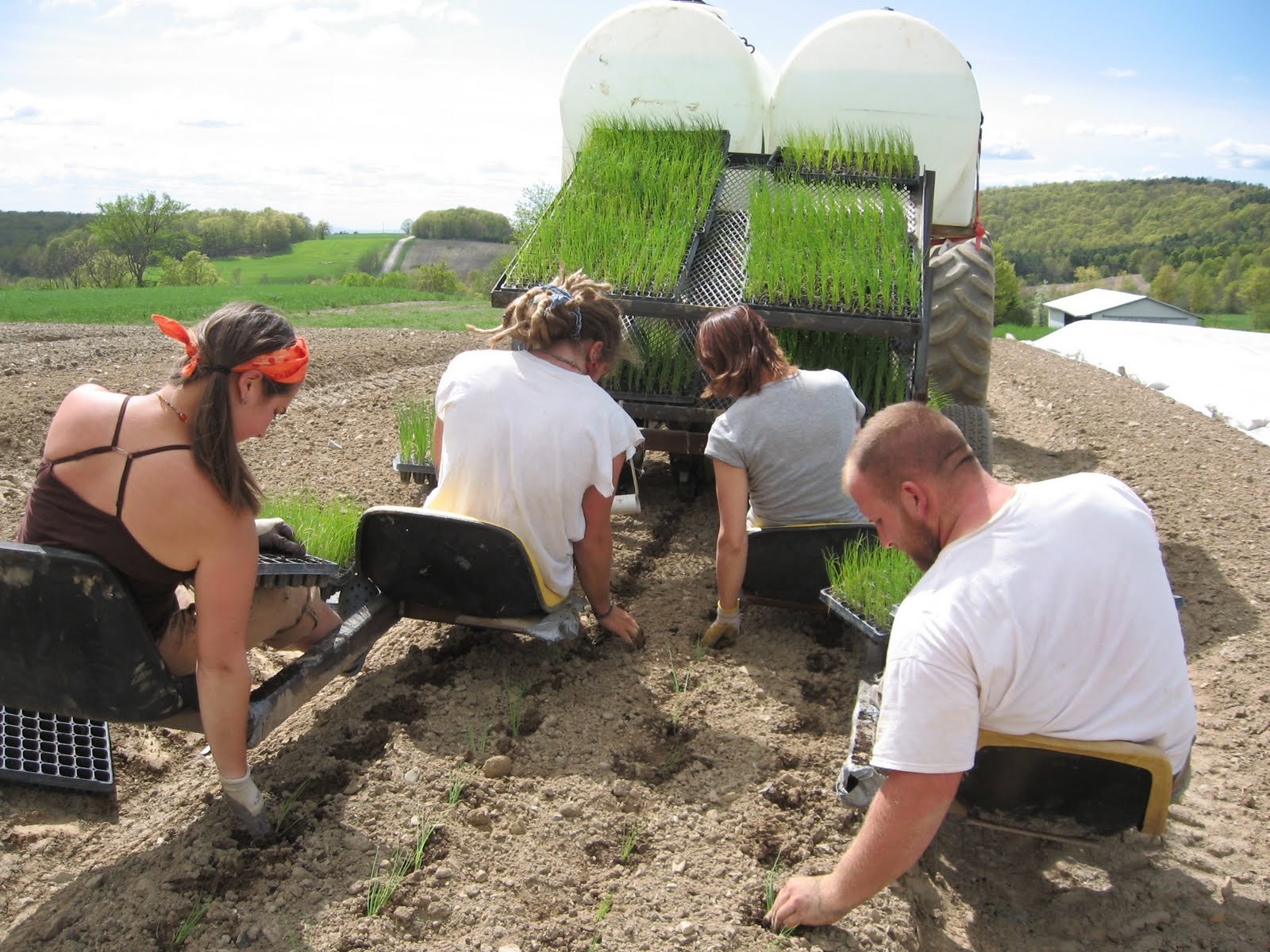
How to Transplant

STEP ONE

Get a tractor with a transplanter attachment that has two giant water tanks and four seats on the back. Fill the prior with water and the latter with people.
(there's room for plants on the back too.)


STEP TWO

Turn on the water and make sure the hoses are in position to distribute water to the waterwheels.


STEP THREE

Pass the plants and don't miss a beat. At 0.3 kph it's easy to get behind, and I'm not kidding. But the guys you see here are pros.


STEP FOUR

Aim straight ahead. Good driving is important for ones own dignity (and Ted's). It's honor among farmers to have straight rows. It all grows just the same, but doesn't look like anyone put Bailey's in their morning coffee.


STEP FIVE

Plant. Get your hands dirty. Chat. And have fun. The tractor may not fly, but the hours certainly do.

Letters from Australia . . .


I was set to start a tomato picking job on the 17th of May, but it was pushed back to first week of June, so I have spent the last couple weeks in a tourist town on the coast called Airlie Beach. Sleeping under the stars and living simply as a sort of personal Thoreauvian experiment in minimal living. You all know I'm fond of these. I have met some lovely people who have taken me sailing, where I climbed the mast with a rope in my teeth and was caught in a storm that broke one of the sail booms and we had to limp back to the lee of an island to escape an angered Poseidon, (or I am perhaps dramatizing somewhat, but the facts here presented are sound) or hooked me up in great angelic generosities with an ocean rafting trip out to the beautiful Whitsunday Islands and snorkeling on the inner reef of the Great Barrier Reef. Visibility was just OK, saw plenty of fish and coral. Lunched on the beautiful Whitehaven Beach, saw giant lizards and eagles and chased the sun and its sharp but diminishing light on its course West at the end of the day. I hope to get out to the real reef before long, since I'm in the area.

My picking job has been pushed back another couple/few weeks, so I'm starting to look for other work, but am not opposed to playing the hobo these few more weeks and getting a more Thoreau (if you mind the pun) experience out of my current experiment and wait for the fruit picking to begin. I think I will be leaving Australia for NZ sooner than planned. I'd planned on November, but may go in may to work on a dairy there in August, which is calfing season. Would be a good experience to get some dairy work. It is at a farm where my sister is nannying for some months. Also would be nice to get my months of work out of the way at the beginning of the trip and have the rest to travel. Or so the plan is going in. You learn real quick when you travel like this that plans change, and that you ought to change out of planning altogether and see what presents itself in the moment. Be where you are!

Well, I guess that's the quick and fast. I hope everyone is well and living. This newsletter thing seems to have taken on a sort of dramatic narrative voice. I've been reading Dickens, if an explanation is needed.

-Jacob